Understanding when you should train and when you should take a day off….

The last several days, the entire house has been entrenched with a GI bug. Or for those of you who do not know what I mean…think diarrhea, nausea, and occasional vomiting. It’s the beginning of what may be a brutal winter so it’s not surprising to me that we are already sick. My husband, James, will usually get sick first. He has idiopathic dilated cardiomyopathy and complex regional pain syndrome.  Or in simpler terms, my husband is a medical hot mess. Please don’t feel bad for me here, it’s one of the reasons why I do triathlon. It’s hard, it’s painful, and it does not even equal what he goes through every day.

So the last few days have been hard because I have not felt myself. I have felt nauseous, and have had diarrhea. Which, as grossed out as you may be right now, are not good things to be having when you are training for anything. Many triathletes may just push through the illness and keep training. But that is a very dumb idea. Sometimes you have to understand when you need to take a break. And I knew that it was time to give my body two days off. Well…to be honest, it was really one day off because the day before I had to go to work and do work things, so resting was not really an option on that front. Another factor to understand is that mental AND physical rest are needed for proper recuperation. And pardon my blunt honesty about bodily functions, but you are reading a blog written by a nurse. We have conversations about gross bodily functions over dinner.

Anyway, this evening, I decided I needed to get back to my base training. And I found that Zwift (14.99/month), has a feature where I can build in my workouts that are dictated by my 80/20 triathlon plan. So I took a few extra minutes and built in what I needed to do. It was wonderful! There is so much of a mind over matter with me because of my chronic anxiety. I often get all worked up if I feel like I am not doing what is prescribed. So in this case, I programmed it in, added my music from Amazon music, and I was off to the races. The shit-eating-grin returned at about 40 minutes. It was nice to feel that this is something that is sustainable.

Anyway, it was the first workout since starting this that I did not feel terrible. I did not feel incredibly tired or stressed. So I guess I am going in the right direction.

So you want to earn a PhD in Ironman?

Hello Everyone,

I know that the tag line and byline for some of you may seem a bit ludicrous. And for some of  you, it may seem like I am being a bit crazy. Even the thought of “how can this random woman take the acronym for a Doctor of Philosophy and bring it down to this?!” Well… first of all, I have a practice doctorate….and I am an actual candidate for a PhD in nursing. So I may have a twisted sense of humor..but by no means am I ever belittling the years of blood, sweat…and oh, so many tears (at least in my case), that it takes to get a PhD. But as my very clever older sister once said as I explained the amount of work and sacrifice it takes to get a PhD, “Em, a PhD can also stand for, “Poor, hungry, and Desperate.”  Which for any of you who have gone through the process, it is a fair assessment.

So what is the point of this blog? Well, often a perception of triathlon is that the more money you throw at it, the better you may be on race day. This is not entirely true. Better equipment can improve your performance, but getting to the podium takes lots of training time, proper nutrition and lots of hard work….oh and definitely some talent as well.  But for many of us, myself included, throwing money at something does not solve the problem. As a nursing professor and PhD student, mom and wife, money does not exactly fall from the sky in my life. But I still wanted to do an Ironman before I turned 40. And there is some consensus that getting a PhD is actually harder than training and competing in a full Ironman. So fuck it, why not? Why not finish my PhD while training for my first Ironman…and…why not try to do it using a little amount of money as possible. Maybe even have some friends from my tri team contribute to this blog to give other perspectives. I mean, not everyone is a professor…we come from all walks of life…teachers, students, bookkeepers, court clerks, paralegals, nursing assistants, secretaries…the list goes on and on….

So first things first…what is the Ironman I am aiming for?? Well, it’s in Canada. As a dual citizen of Canada and the U.S., I think this is only fitting. Second, an Ironman is almost $800, IF I have to pay the entry fee rather than raising money (which I may do if the opportunities arises), it is the most I am spending for the entire training cycle. My budget for the entire Ironman including entry fee, training, lodging, and gas, is $1500. If I can get on Team IMF (Ironman Foundation), which is a very good cause that supports local charities in the areas that hold the event, then my budget shrinks to $700 total.

Since this event is scheduled for August 2020, $700/12 months =$58.33/month

If no team INF, then the budget is $1500/12= $125/month

That’s it…. and to put this in to perspective, when I take my 10 year old and my husband to the movies, the cost is a minimum of $75. So my goal is to accomplish my training/entry/lodging by spending less than the cost of a night out at the movies with my family per month. Or…at least, less than the cost of 1.5 nights out at the movies if I have to paid that registration fee.

I know I sound crazy….well, I am about to sound a little more nuts for you veterans. Everyone I have ever spoken with has said that you should never do a long distance triathlon without a coach…and I would agree…if you are a new person to the entire sport. I had a coach. She was wonderful but she was expensive and as much as she is a wonderful human being, we were not a good fit. I have an autoimmune disorder and I did not fully understand the magnitude of the stress that an intense training cycle can put a person under. I admit I was not always able to complete my workouts and this was due to the severe fatigue I felt on a daily basis.

So rule number 1 for this triathlete…. Quality training weighs more than the quantity.

Rule number 2: Consulting a coach for advice is OK, hiring a coach who does not specialize in women triathletes with autoimmune disorders is forbidden. 

Rule number 2 also supports the budget. Again, this entire premise may seem foolhardy but heck, keep reading my blog for pure entertainment on how this actually turns out. It may surprise you…hell, it may even surprise me. 😉

Instead, I am pulling together my own plan, which I do plan on posting. It is a hybrid of sorts based upon the idea Coach Matt Dixon has put forth regarding high quality workouts for people with little time.

And for those of you who may say “have you LOST YOUR MIND?!” My answer is, nope, but I am a healthcare professional, who has completed one 70.3, many sprints and olympic triathlons…and 5 marathons….including 2 Boston Marathons (as a charity runner, I can BQ when I’m 80.)  And more importantly, I know my own body, and I know that quality workouts work. I PR’d at the Ottawa Marathon doing just that. I ran less, but did more high quality workouts, and I did well. I did hit the wall, but I understood that my nutrition needed work. Now I believe I have figured that out. Part of this journey is to understand how all of us with a limited budget can do an Ironman using things that we find around our every day grocery store. So in some ways, there are some experiments going on…but do not worry, it’s only my body I’m putting at risk…if you so wish to mirror what I am doing, you do so at your own peril.

So if you are here for entertainment, or advice, every journey starts with the first step….. so sit back, relax, and enjoy the ride…. 20190601_103855
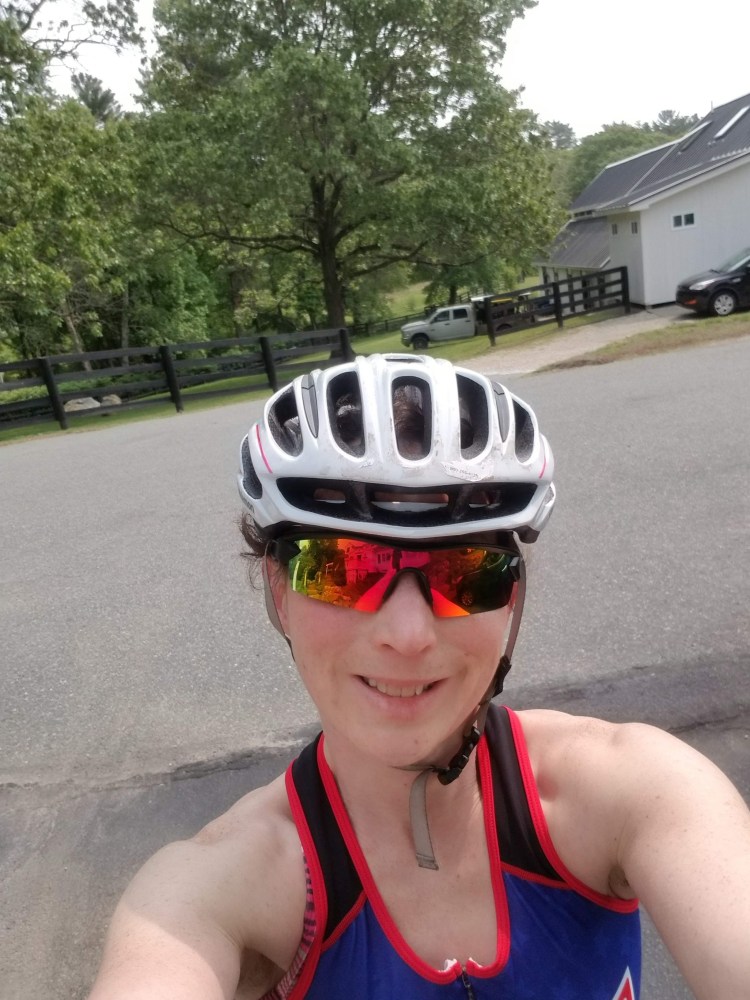
Me after a nice ride outside….

The Training Begins…..

Well, it’s been 2 months since I last wrote. Part of this is because I was trying to figure out exactly what I wanted to do. Another part of it was, with my new position as an assistant professor in nursing at a local community college, what would I actually have TIME to do. The mission is still the same here. Try to do this with as little money as possible but something I had failed to write in to my low cost plan what the amount of time that creating my own training plan may consume, especially when I wanted to translate the training from a printed book to Training Peaks.

Well, after struggling for weeks to even find the time to write down the training blocks of what had to be done when, I threw up my hands and gave up. More precisely, I logged on to my old Training Peaks account and stumbled upon pre-built plans that met my criteria. As I have stated before, the factor of some plans running your ass in to the ground is always a significant concern. I have psoriatic arthritis and I battle with constant fatigue. It’s not a fun day at the picnic when your body makes you feel like two giant bags of sand are just sitting on your legs all day while your feet are aching and on fire from the inside out. To be honest, I really try to not complain about my pain as much but my students, often ask me why I am limping at times. I just smile and say it’s a bad arithritis day. Anyway, back to the pre-built plans. I found the 80/20 endurance plan on Training Peaks and as I read, it was meeting my criteria. The philosophy of the 80/20 plan is to execute good, quality training at a low to moderate intensity 80% of the time and high intensity training 20% of the time. My past experience has taught me that this could work out in my favor. Add in the fact that the plan is $29.95/month including a premium subscription to Training Peaks (TP) (which can cost $19.95/month by itself), and you have a bargain. Also, to consider, the fact that a coach can cost between $175 and $250/month, $30 seems like no big deal in comparison to that. Sure you do not have 100% access to your coach, but to be honest, it sounds more glamorous than it is. I honestly had no issues with my last coach. She was great! But by the time I was done with my tri training with her, I felt that I could do almost the same for less money.

So with that decision made, Dave Warden and Matt Fitzgerald (not to be confused with Matt Dixon from “Fast track Triathlete”, are now my indirect guides on this Ironman journey. And so far, what they are asking, does not seem unreasonable. One thing experience has taught me is that I have to keep myself calm when I see all of the base training written in to my schedule now. My immediate thought is “how the hell am I going to get this done?!” But then I breathe and remember that I can do this, just one thing at a time. Keep moving forward.

Mind over matter

    The mantra of “keep moving forward”, is one that I have chanted to myself over the last year, and tonight was no different. So after a long day at work, I came home knowing I had to run for 30 minutes. Since I had been gone all day, running outside was not an option. I have a husband of 14 years and our 10 year old son, would not be very amused if I got home and immediately left again. Luckily, I have a treadmill in the basement along with a Wahoo Kicker, so I was able to get myself in to gear. I bought both earlier this year used because I missed having a treadmill. The kicker was bought because I have been uneasy on the roads where I live and it is getting more dangerous than ever to take my bike outside. People are crazy and I was not tempting fate if I did not have to.  The Kicker is a smart bike trainer which is integrated in to software programs which simulate real world cylcing such as Zwift. Should I have included these expenses in to my Ironman budget? Maybe, but I really do not think so because I bought them knowing I would use them regardless if I am doing an Ironman or not.

So, my training is based upon heart rate. No big deal, I have a HR monitor that connects to my watch. 5 minutes in Z1, 20 minutes in Z2, and 5 minutes in Z1. This is where mind over matter comes in because I have lost quite a bit of fitness over the last year. More than I’d like to have lost. It’s my fault for slacking. I chose to go after getting a PhD and my training suffered for it. Hell, everything suffers when you are in the pursuit of a PhD! As I am running on the treadmill, watching an old episode of “Arrow”, I start to get hot and bothered, my legs start to ache and I have no music in my ears to distract me. The episode of “Arrow” was terrible but I think this is a good first step to training with no music. I wanted to stop but I kept thinking that I had only 30 minutes to run and I could get through that. I accidentally did the 10 minutes of Z1 at the beginning but considering I had not run at a consistent rate, it was probably for the best I did it that way. While I was running, my husband came to see me and to check on our son, Alex. He talked to me for an minute, then to Alex, (who was watching TV in our finished basement where my treadmill is located), and it became clear to me that this training might work. My relationships with my family suffered during my last serious training, this time, I am determined to not let that happen again. As a PhD candidate, being skeptical is part of our baseline. We are taught to question everything! And we do…all…the…damn…time.

I kept an eye on my HR for the duration of the run. I wanted to quit and walk soooo many times but I kept looking at the clock on the treadmill and reminding myself that I could do this. And I did. 🙂 I got off the treadmill with a shit-eating grin on my fact that I could not wipe off. It had been a long time since I had a smile like that after a run. It was hot, it was hard, it was REALLY slow pace. But what my life has taught me over the last several years is to have so much patience. Because, I do not know of many people who feel amazing while running. Rule of thumb is that you often feel like shit during the run and like a million dollars after the run.

So the financial breakdown so far….

Ironman Mont Tremblant Fee  $800

80/20 Endurance Plan $29.95/month

Zwift $14.95/month


And so the Ironman training Saga begins……